In This Issue
Arturia Memory V Memorymoog Software Emulation Is Here

It’s part of the sound of Chick Corea, Rick Ocasek, Paul Haslinger, Mark Mothersbaugh, and many others
Does the world need yet another software emulation of a famous analog synth? Absolutely! They all have a unique sound, somewhat different updated features, of course different presets (which may be the biggest difference), and of course Arturia has proven themselves to be pretty good at this.
Here’s the company release:
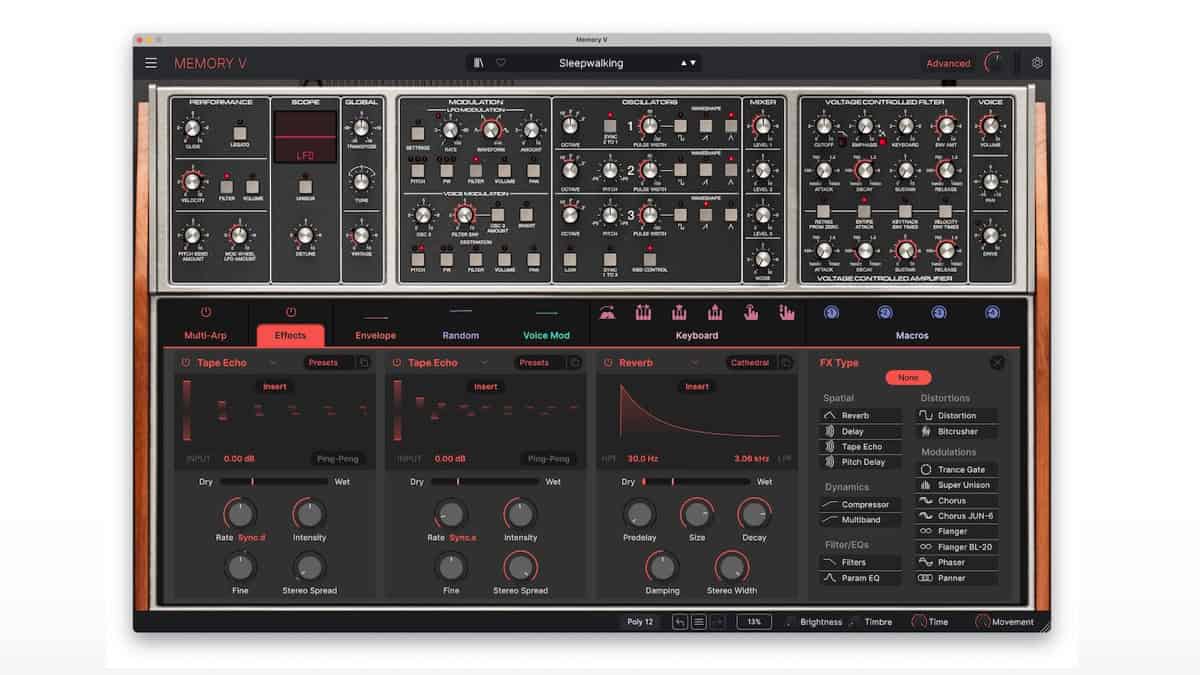
Memory V is Arturia’s definitive take on the Memorymoog — the iconic polyphonic powerhouse built for sheer sonic dominance.
Designed for dense, front-of-mix presence, it excels in delivering powerful leads and towering analog brass with unmistakable weight and character.
Memory V faithfully recreates the raw power and instability that made the original legendary, translating its unpredictable analog behavior into a modern, reliable instrument — without sacrificing its edge.
WIELD PHENOMENAL POWER
Feel the power of a true analog titan. Memory V delivers huge, dense, front-of-mix polyphonic tone with unmatched weight and presence.
The sound engine specifically models the unique architecture of the Memorymoog, featuring three voltage-controlled oscillators (VCOs) per voice, alongside its deep oscillator sound and distinctive ladder filters, delivering massive, rich polyphony.
ABOUT MEMORYMOOG
Released between 1982 and 1985, the Moog Memorymoog stands as the only true polyphonic analog synthesizer of the original Moog era—and its final flagship before bankruptcy.
Described as “The Ultimate Sound of Moog” or “6 Minimoogs in one”, it delivered 6 voices, each with 3 oscillators, marking the peak of their ambition.
At the edge of the analog era, it brought a new scale to synthesis—delivering exceptional weight, density, and presence in polyphonic textures.
Today, it remains one of the rarest analog legends: a maximalist instrument of immense sonic power, defined as much by its instability, fragility, and cost as by its sound—reserved for dedicated collectors.
ENHANCED FOR MODERN PRODUCTION
Beyond a direct emulation, we added some features to augment the instrument, making it tailored for modern music creation.
– Modelled Moog Ladder Filter TAE©
– Modelled Triple VCOs, Mixer and VCAs with its non-linearities, boosted by an added Drive control
– Multi-Arpeggiator
– Arturia Advanced Features: Drag & drop modulation system, Effects – MPE, Arturia Controller Integration, NKS, MTS-ESP – Sync 1 to 3, allowing gnarly sounds – Enhanced modulation options with an added panning control – 6 voices, expandable to 12
TITANIC UNISON
The Unison mode stacks up to 6 triple VCO voices into a single, massive mono voice, unleashing dense analog tones and unmistakable grit of 18 oscillators.
10 COOL THINGS TO HAVE FUN WITH
_Instant Vintage Vibes Browse the 300+ presets and find your Synthwave, Ambient, R&B starting point in seconds. The Memory V allows for instant access to the legendary Memorymoog sound that you can sculpt further thanks to our finely tuned macros.
_Classic 80s Polyphonic Pad Set all three VCOs to sawtooth, close the filter cutoff to about 60%, slow the ladder filter envelope attack and the VCA attack together, add a touch of reverb and chorus — and you’ve got the fat lush, cinematic Moog pad sound that defined an entire decade of synth pop and film scores.
_Evolving Polyphonic Keys From your key presets, augment it using the Velocity Env Times feature, plus the Voice Modulation section to introduce subtle per-voice variations in envelope times, pan, pitch, filter or volume. Each voice of your chord will breathe slightly differently, turning a static sound into a living and organic chord, perfect for cinematic scoring and ambient production.
_Drive into Saturation Push the per-voice Drive knob gradually while playing dense chords. At low settings it adds subtle harmonic richness; past halfway it introduces the raw, crunchy analog grit the Memorymoog was notorious for. Combine with a slow filter opening and you have a signature “angry Moog” moment that cuts through any dense mix.
_Raw Synced Synthwave Lead Set OSC1 to sawtooth, OSC2 a fifth above (7 semitones), engage the sync 2 to 1. Dial a snappy filter envelope with fast attack and medium decay, nudge the Drive, and you have a cutting, aggressive lead tone that sits perfectly in an 80s-inspired synthwave track.
_Vintage Moog Bass Set OSC1 to sawtooth, OSC2 to square and drop it an octave below. Close the ladder filter cutoff around 40% and toggle the emphasis bass compensation to keep the low end tight, add a punchy filter envelope with fast attack and medium decay, and push the Drive slightly for that signature Moog grit. A front-of-mix bass that needs no EQ.
_Pure Analog Instability The original Memorymoog was famously unstable — recreate that magic intentionally. Route the LFO to the pitch of your VCOs at very low depth and a slow rate. Adding the Vintage dispersion knob, the result is subtle, breathing detuning that sounds alive, not perfect.
_Rhythmic Moog Arpeggio Engage the Multi-Arpeggiator, set the pattern to a dotted-8th rhythm, and let the ladder filter’s natural warmth give every note its characteristic weight. Layer a second arp voice an octave up with a different pattern for instantly complex, interlocking Moog melodic lines.
Price: $149 (various offers available)


Arturia Memory V Memorymoog Software Emulation Is Here

Enter the Win a Sequential Fourm! Ends May 31, 2026

BLEASS Spectral Resonator – That Robotic Sound

Synth Repairs: Long Waits, High Prices

Novation Announces Release of the Successor to its Popular FLkey Range of MIDI Keyboard Controllers

Native Instruments Absynth 6: the Synth and Software Review

Sounds Created from Hans Zimmer’s Personal Library

ELI Announces Four-Section ParaDyn™ Parametric EQ Plug-in

u-he Zebra3 – the Synth and Software Review

Melbourne Instruments brings Braids engine to desktop NINA analog polysynth
-

 Covers4 weeks ago
Native Instruments Absynth 6: the Synth and Software Review
-
In This Issue4 weeks ago
Sounds Created from Hans Zimmer’s Personal Library
-
Dynamics4 weeks ago
ELI Announces Four-Section ParaDyn™ Parametric EQ Plug-in
-
In This Issue2 weeks ago
u-he Zebra3 – the Synth and Software Review