
Features
Tangerine Dream: the Dream Continues

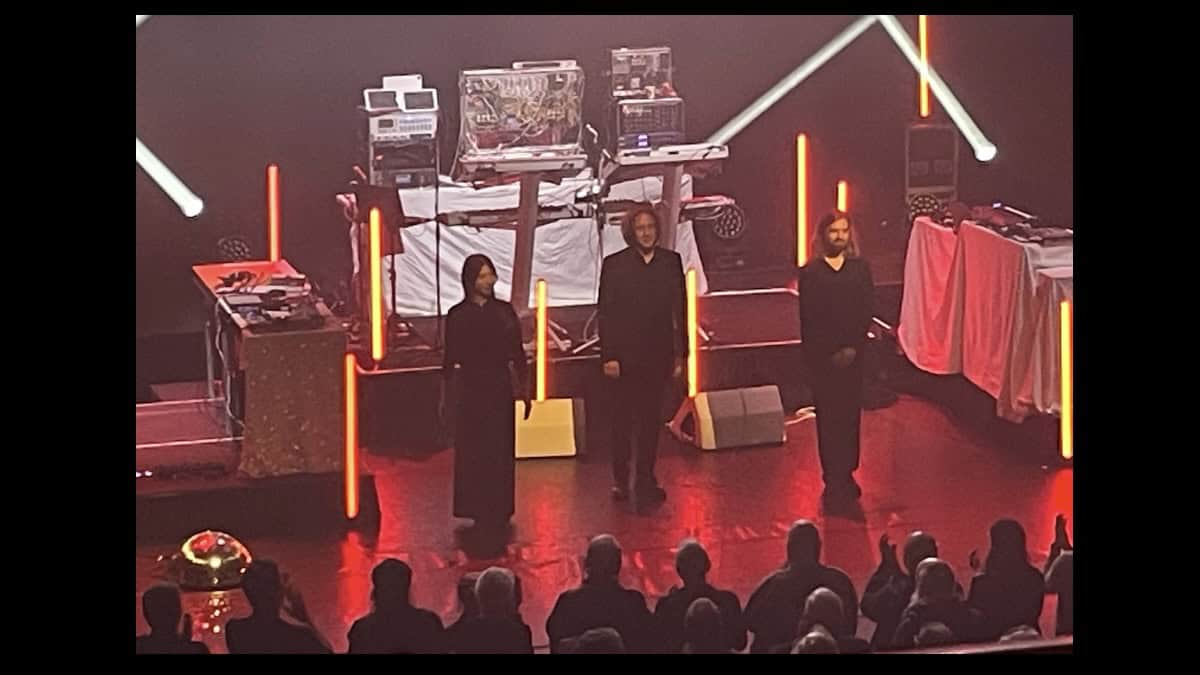
The pioneering electronic music group’s latest high-tech incarnation
Anniversaries continue to whiz past for Tangerine Dream, the world’s longest-lived electronic music group. This time around, caught in concert at the prestigious Barbican Hall in central London, they’re celebrating the 50th anniversary of “Phaedra,” their debut album on Richard Branson’s Virgin Records.
Not that any of the current members were around at that time – the existing trio are much too young, but have convincingly inherited the Tangerine Dream spirit. Musical director and keyboardist Thorsten Quaeschning joined the group under founder Edgar Froese in 2005; violin and electronics expert Hoshiko Yamane a little later, and Paul Frick (previously with the group Brandt Brauer Frick) most recently, in something of a post-lockdown shakeup.

In its entire 54-year history of album releases, the band has gone through several incarnations and experimented with many additions to the formula – drums, rock vocals, saxophone, flute, string quartets, percussion, a lot of electric guitar, operatic voices, vocoders, and more. But the current version is somewhat stripped down to the central core of electronic keyboards, plus Hoshiko’s violin and on this occasion some wood flute or shakuhachi from Thorsten.
So what circuitous route led us to this current lineup?
Tangerine history
Tangerine Dream was formed in 1967 by Edgar Froese, the band name coming from the album of that year by US psychedelic group Kaleidoscope. Froese, playing guitar in a blues/soul covers band called The Ones, had visited surrealist artist Salvador Dali and become much more interested in playing improvised psychedelic music.

Froese had also been listening to early Pink Floyd, using the opening chords of “Interstellar Overdrive” to lead into long improvised jams for guitar, drums, and either bass, flute, cello, saxophone, organ, or other instruments.
In 1970, the band’s first album “Electronic Meditation” was released. It was taken from improvised sessions by a 5-piece of guitar, drums, cello, flute, and organ (the latter pair uncredited on the original release).
The album not very electronic – synthesizers such as the Moog Modular, released in 1964, were barely known in Germany at the time – but it’s certainly electric, with thrashing guitar underpinning frantic drums (by Klaus Schulze who went on to have his own lengthy career in synthesizer music) plus random tapes, percussive noises, and backwards voices.
After that album the band really did become electronic, adding organs with effects units, then early synthesizers, echo units, and sound effects. Following the success of Mike Oldfield’s instrumental “Tubular Bells” in 1973, and under the influence of legendary British radio DJ John Peel, Richard Branson wanted other instrumental groups for his Virgin label. He took on Tangerine Dream with “Phaedra.”

Collecting Tangerine Dream
Being a collector of Tangerine Dream recordings is hard work. There are perhaps 100 official albums divided into periods before and then with Virgin, then with Zomba, Private Music and Miramar in the USA, and on to the band’s own label Eastgate.
Most listeners have their own preferred period, because the stylistic differences are vast, mainly due to the available technology changing all the time. Tangerine Dream jumped on opportunities to use modular Moog synthesizers, then polyphonic analog synths, sampling, digital synthesizers, software, and so on.
The band also innovated in the use of computers on stage, and often added spectacular visual shows. That includes Laserium, on a 1977 US tour from which the much-loved live double album “Encore” is taken.
So first there’s a “kosmische” psychedelic and ambient period of three albums, then a long period with Virgin based mostly on using analog sequencers, increasingly sophisticated music for Zomba, then a move into more conventional and perhaps “New Age”-style melodies for the US-based Private Music.

After that time the band released through their own label, with a stream of albums based on soundtracks, revisions of earlier releases, live concert recordings, and so on.
Because the band often improvised live so that every concert was different, there was a busy trade in bootleg recordings. A semi-official project was launched to gather them together, called Tangerine Tree.
So to own absolutely everything including singles and EPs, solo projects by various members, compilations, boxed sets, and more recently limited run releases on vinyl, you’re looking at well over 300 items.
Quantum years
Founder Edgar Froese passed away in 2015, and there was a brief period when the future of the band was in doubt. Edgar’s son Jerome had played with the band for some years, but by that time having left to pursue his own career.
There wasn’t much of a gap, though, before the band resumed operation for the so-called “Quantum Years” under busy soundtrack composer Thorsten Quaeschning, who divides his time between creating the band’s new music and arranging past releases for concert performance.
At the Barbican show, the concert opened with the whole of the “Phaedra” album – played in reverse order for dramatic purposes – then a long improvised “Session” of slow ambient music leading into pounding sequencers and drums.
Thorsten runs the sequencers (including the Manikin “Schrittmacher”) and a mostly Doepfer Eurorack modular system, while Paul Frick plays digital piano and small keyboards, and Hoshiko plays violin and effects.
There’s a constant visual display, mostly abstract so as not to impose any particular theme onto the music, though at times showing the band at work in the studio, or enjoying nature outdoors…
In the second half, several more classic album tracks were played, including from the movie soundtrack “Sorcerer” and the mid-period album “Underwater Sunlight.” More recent music came from the Eastgate releases such as “Raum,” a track used on “Grand Theft Auto,” and a final encore returning to the resonating analog-style sequencers with a forceful more percussion-oriented mix.
A sell-out crowd at the Barbican really appreciated the wide span of styles and textures, from gentle flute to pounding drums and abstract analog effects.
In the post-COVID era, Tangerine Dream has re-established an annual schedule of tours around Europe and UK, and they even reach the USA on occasion with a slightly stripped-down set of instrumentation.
Whether you start counting from the band’s foundation in 1967 or their first album release in 1970, it now looks pretty much certain that the band will still be up and running for a fast approaching 60th anniversary – which will be an achievement indeed.
Band photo – Melanie Reinisch/Eastgate
Stage photos – Mark Jenkins
Closeup photos – Bill Cook


Native Instruments Absynth 6: the Synth and Software Review

Sounds Created from Hans Zimmer’s Personal Library

ELI Announces Four-Section ParaDyn™ Parametric EQ Plug-in

New Drum Farm Eurorack Module


