Features
Cherry Audio Atomika – the Synth and Software Review

The Polyvoks rises again – Cherry Audio Atomika
Cherry Audio has a habit of coming out with excellent sofsynths at a silly price – that is, silly because it’s so low. Their fabulous GX-80 is one of my four favorite softsynths on the planet, and it sells for… $59?!

But don’t be prejudiced by $49 the price of their latest synth, Atomika. This instrument was done by the same guy who did the GX-80. It’s an emulation of the Polivoks synth from the former USSR – but with 2024 additions, including 16-voice polyphony and extended filter types.
The Polivoks was made in the dusk of the Soviet empire, manufactured in the Formanta Radio Factory from 1982 – 90. Atomika even has a preference to substitute the English control labels with Cyrillic, for those interested in authentisky.

This is actually a very simple “analog” synth that requires almost no explanation. Its wonderful edgy sound is due to its positively nasty filter. Cherry Audio explains that it’s not a typical transconductance filter used in standard variable state designs (meaning ones with selectable types – hi/lowpass, notch, etc.)… but let’s stop there, let someone get the impression that the reviewer doesn’t know anything about circuit design.
Instead, let’s just report that the original filter used an op-amp not intended for audio, adapted for the Polivoks because that’s what was available in Cold War USSR. But Cherry Audio provides different filter types in Atomika – an example of the 2024 adaptation.
You can read all the bumph about this instrument here, including the features they added to the original by clicking here.
I’d also suggest checking out this excellent video overview.
Impressions
While Atomika is most likely to get called for the gig when you’re after some edge – after all, that’s its calling card – it’s perfectly capable of making the kinds of sounds you expect from any analog synth, and then some. Its sound quality can be as rich and full as the best of them.
Taken as a whole, the factory sounds are very well programmed, and above all useful musically. They cover a lot of ground, from effects to standard filter sweeps to some very cool keyboard sounds (check out Russian Suitcase for a dusty old sound that’s been stored in an attic for decades, for example).
There’s also a set of percussion patches with a lot of impact. You’ll need to use multiple instances of Atomika to play more than one at a time, but these are not your typical cheesy synth percussion sounds.
The other day I happened to be looking for something electric with the effect of an organ, definitely not an emulation, so probably a synth organ… but mainly it needed character, because the cue starts with it alone and it wanted to be arresting.
And by coincidence Atomika arrived for review just then. Behold the Crystal Clear preset – although as you can hear, it’s pretty intense and I rolled off a lot of top end in the mix.
Engine
The instrument itself is straightforward, and anyone who’s used an analog synth will understand it right away and not be afraid to tweak. For that reason it would also make a good learning instrument.
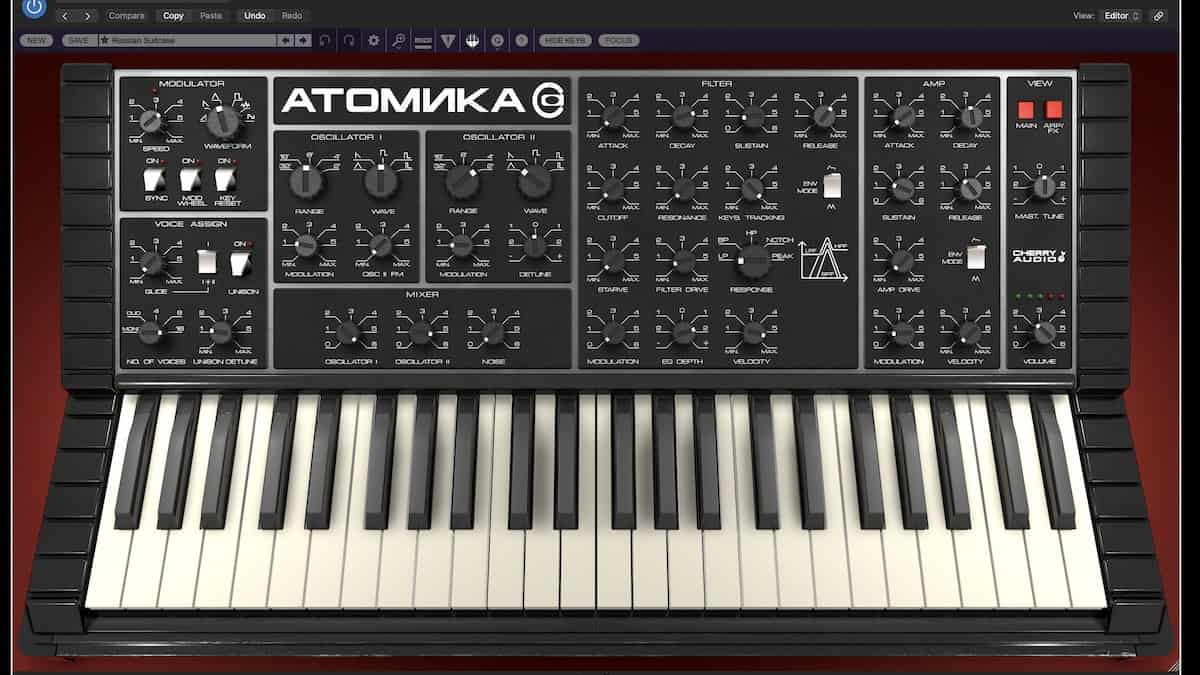
Atomika is a 2-oscillator synth with ADSR envelopes that can loop, one for amplitude and another for the variable state filter. Both oscillators have the same five waveforms available, as you can see, plus there’s a white noise generator (hardly a unique feature, but certainly a useful and characteristic one for classic analog sounds).
There’s one modulator for the synth engine, with six waveforms, including noise and sample & hold. It can sync to your DAW tempo, as one would expect today, but of course there were no DAWs in the USSR.

Interestingly, there’s another modulator just like the synth one for the effects (press a red button and the entire interface switches over). As you can see, the modulator affects different parameters depending on the effect: Phasor, Flange/Chorus, Echo, and Reverb.
These effects are a highlight of the instrument. They sound excellent, they’re simple to use, and the factory sounds make great use of them. The Polivoks didn’t have them.
Oh, and Cherry Audio added an arpeggiator. There’s a whole section of factory presets that make great use of it.
Ergo
This is another no-brainer instrument from Cherry Audio – and not just because the price is so low, but because it’s hard to imagine any musician not getting a lot of use out of it.
Price: $49


Introducing Absurdly Quiet Piano Pro

Solid State Logic Introduces the SSL 1 Audio Interface

New From AAS – Organix for Chromaphone

The Passing of Jack Hotop, Legendary Sound Designer and Innovator

Arturia Memory V Memorymoog Software Emulation Is Here

u-he Zebra3 – the Synth and Software Review

New Quadtrack Computer-Based Groovebox
Arturia Memory V Memorymoog Software Emulation Is Here

New AAS Acacia Fantasy Pack